


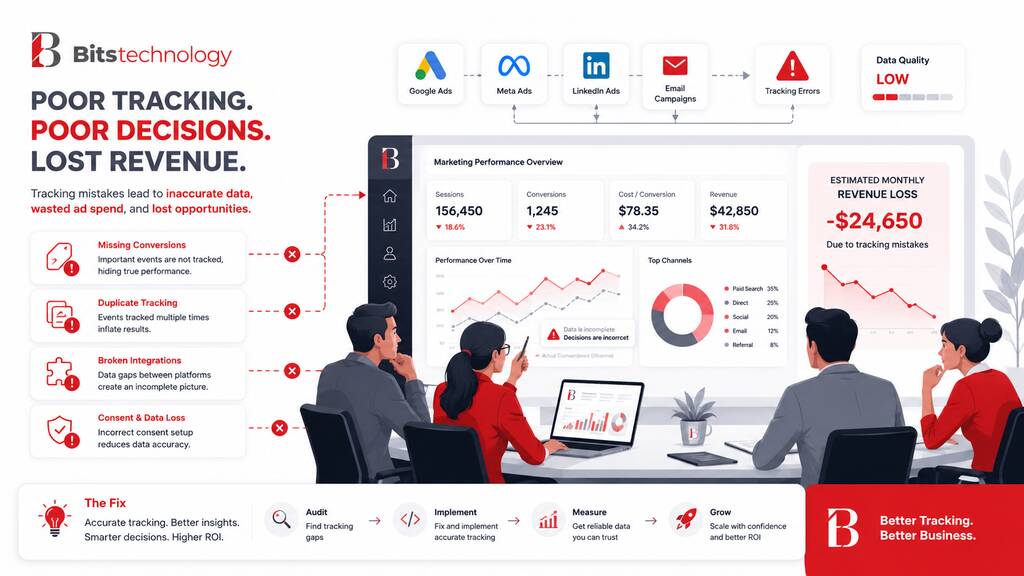
Tracking Mistakes That Quietly Destroy Marketing ROI
Businesses invest thousands of dollars every month into advertising, content marketing, SEO, and lead generation campaigns. To evaluate performance, they rely on analytics platforms, dashboards, and conversion reports to guide critical marketing and budget decisions.
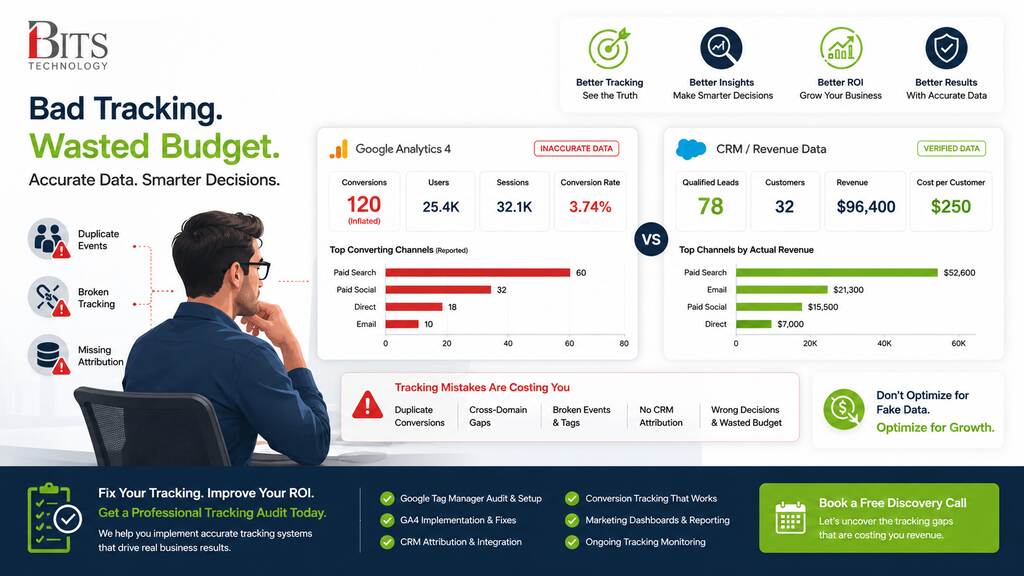
The challenge is that many organizations unknowingly operate with inaccurate tracking. A website may report conversions that never happened, miss qualified leads entirely, or attribute revenue to the wrong marketing channel. These tracking mistakes create a distorted view of what is actually driving business growth.
When the underlying data is flawed, marketing teams often optimize campaigns based on incomplete or misleading information. Budgets get shifted toward underperforming channels while high-performing opportunities remain hidden.
As businesses scale, even small tracking errors can compound into significant financial losses. Decisions regarding advertising spend, campaign performance, and customer acquisition become increasingly difficult to trust.
Before investing more money into marketing, organizations must ensure their measurement systems are accurate. Reliable tracking provides the foundation for smarter decisions, better attribution, and stronger marketing ROI.
Pitfall #1 – Tracking Page Views Instead of Business Outcomes
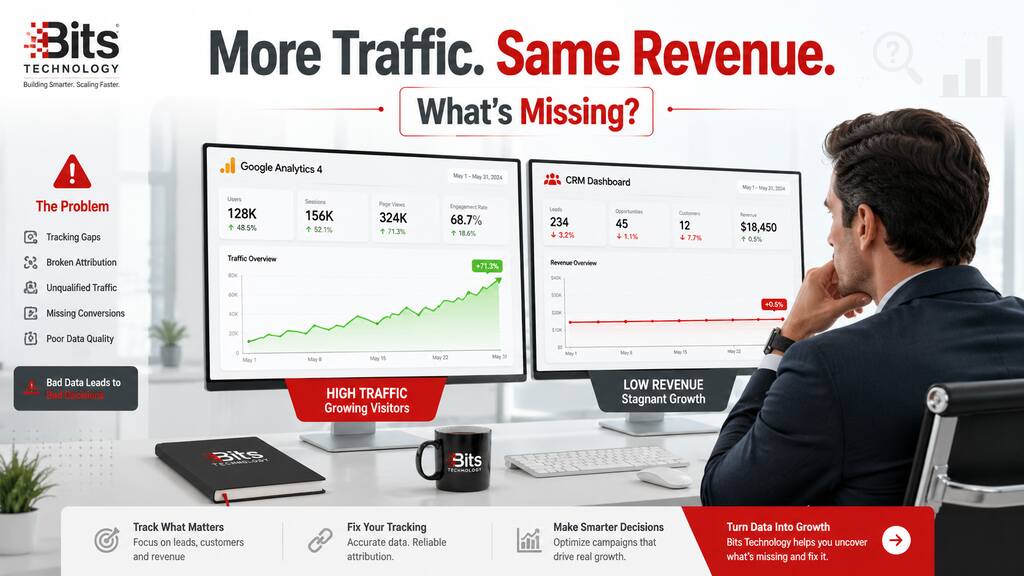
One of the most common tracking mistakes businesses make is measuring success using only page views and website traffic. While these metrics can indicate awareness and interest, they rarely reveal whether visitors are becoming customers. A campaign generating 10,000 page views may appear successful, but if it produces no qualified leads or sales, it contributes little to business growth.
Traffic metrics become especially misleading when marketing teams focus on increasing visits without understanding visitor intent. High traffic can result from broad targeting, irrelevant keywords, or viral content that attracts the wrong audience. In these situations, page views grow while revenue remains unchanged, creating a false sense of performance.
Instead of prioritizing traffic alone, businesses should focus on measurable business outcomes. Key metrics include form submissions, phone calls, booked appointments, demo requests, and qualified leads. These actions demonstrate genuine engagement and indicate whether marketing efforts are moving prospects through the buying journey.
The next step is connecting leads to revenue through CRM and attribution tracking. By linking marketing channels with sales outcomes, organizations can identify which campaigns generate actual customers rather than simply attracting visitors. This provides a much clearer picture of marketing effectiveness and return on investment.
Ultimately, successful businesses track the complete path from traffic to lead, lead to customer, and customer to revenue. When decisions are based on outcomes instead of page views, marketing budgets can be allocated more confidently, performance can be optimized accurately, and growth becomes predictable rather than speculative.
Pitfall #2 – Broken Google Tag Manager Implementations
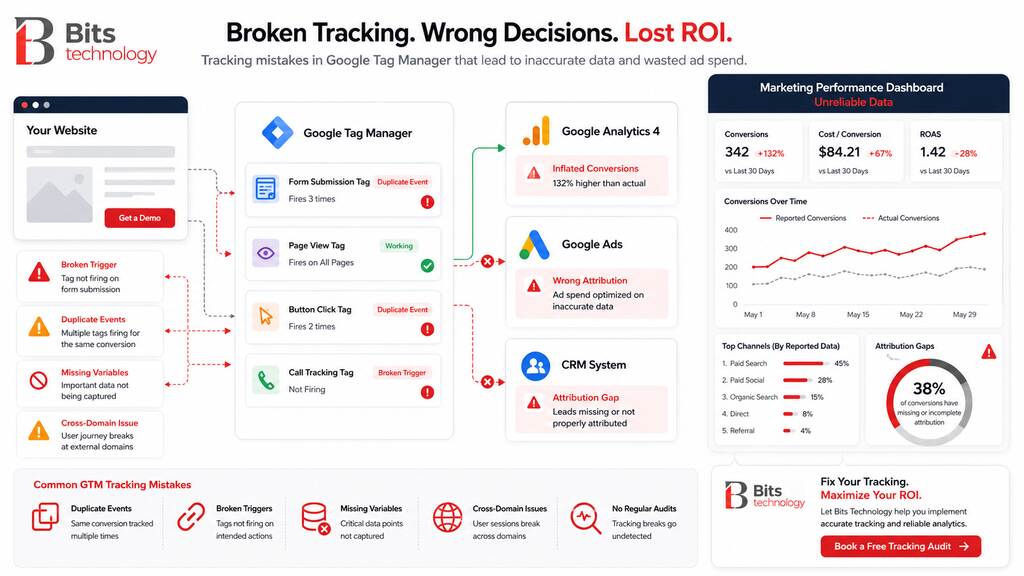
One of the most common tracking mistakes in Google Tag Manager is incorrect trigger configuration. Businesses often set tags to fire on every page load or multiple user actions instead of the intended conversion event. This can inflate conversion counts and create a false sense of campaign performance.
Duplicate event tracking is another major issue. A form submission may be tracked through both a thank-you page view and a button click event, causing the same conversion to be recorded multiple times. As a result, marketing reports show higher conversion rates than actually achieved.
Many organizations also fail to properly test their GTM implementation before deployment. Missing variables, broken triggers, or JavaScript errors can prevent critical conversion events from firing, resulting in underreported leads and inaccurate performance analysis.
Cross-domain tracking misconfigurations frequently break attribution reporting. When users move between websites, landing pages, scheduling tools, or payment platforms, their session data may be lost, making it difficult to understand the true customer journey.
Finally, businesses often neglect ongoing audits after website updates. New forms, redesigned pages, and plugin changes can silently disrupt tracking. Regular reviews of Google Tag Manager configurations help identify tracking mistakes early and ensure marketing decisions are based on reliable data.
Pitfall #3 – No CRM Attribution
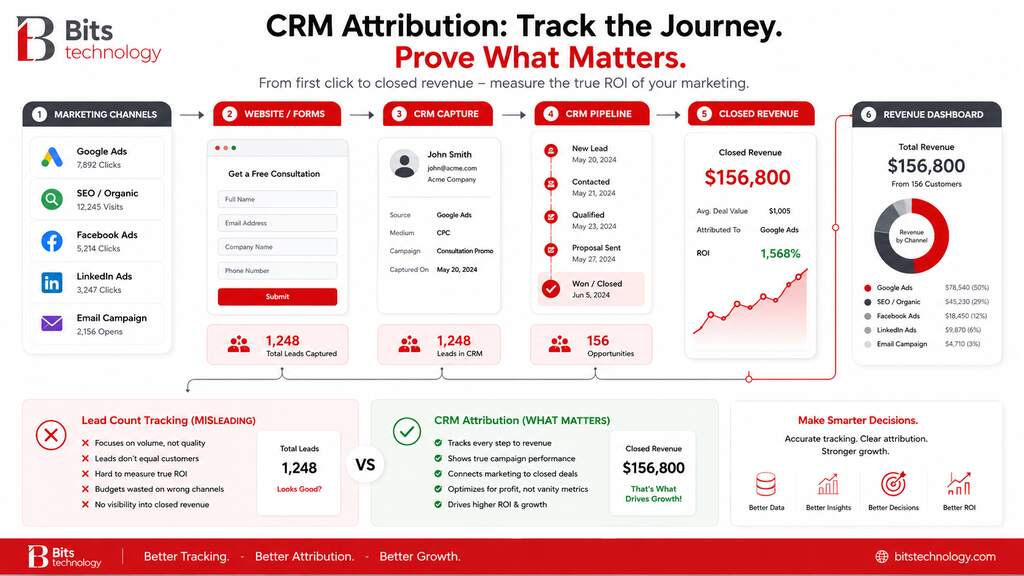
Many businesses evaluate marketing performance based on lead volume alone. While generating leads is important, lead counts rarely tell the full story. A campaign that produces 100 leads may appear successful, but if only a handful become paying customers, the actual return on investment can be disappointing. This is one of the most common tracking mistakes businesses make when measuring marketing effectiveness.
CRM Attribution connects marketing activities to actual sales outcomes. Instead of stopping at form submissions or phone calls, it tracks leads throughout the customer journey, from first interaction to closed revenue. This allows businesses to identify which channels, campaigns, and keywords are generating real business results.
Without CRM Attribution, marketing teams often optimize for low-quality leads because those conversions appear positive inside analytics platforms. As a result, budgets may be shifted toward campaigns that increase lead volume but contribute little to revenue growth.
Accurate attribution also improves collaboration between sales and marketing teams. Both departments can work from the same data, helping them understand which marketing efforts produce qualified opportunities and which ones simply generate inquiries.
When revenue is connected to marketing data, decision-makers gain a clearer view of true performance. CRM Attribution eliminates guesswork, reduces costly tracking mistakes, and enables businesses to invest confidently in the channels that drive profitable growth.
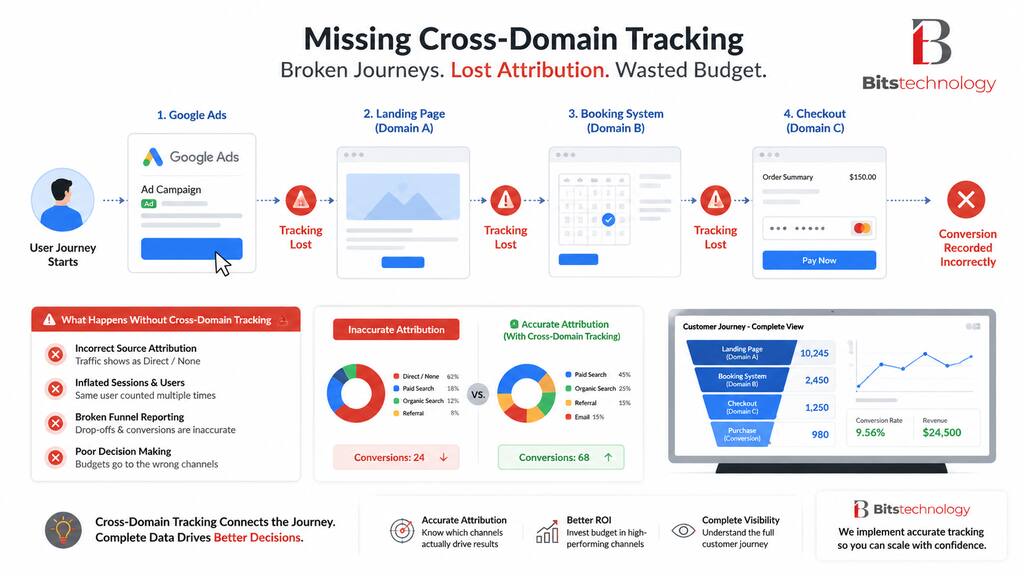
Pitfall #4 – Missing Cross-Domain Tracking
One of the most overlooked tracking mistakes is failing to configure Cross-Domain Tracking when users move between multiple websites or platforms during their journey. Many businesses use separate domains for landing pages, booking systems, payment gateways, customer portals, or eCommerce checkouts without realizing that analytics tools may treat the same visitor as multiple users.
When Cross-Domain Tracking is missing, the original traffic source can be lost as visitors move from one domain to another. A customer who initially arrived through Google Ads, organic search, or email marketing may appear as a direct visitor on the second domain, creating inaccurate attribution data.
This fragmented journey makes it difficult to understand which marketing channels are actually generating leads, sales, and revenue. Campaign performance reports become unreliable, causing businesses to optimize budgets based on incomplete information.
Missing Cross-Domain Tracking can also inflate user counts, increase session fragmentation, and distort conversion rates. As a result, marketing teams often struggle to identify bottlenecks and accurately measure return on investment.
Proper Cross-Domain Tracking ensures a seamless customer journey across websites and platforms, preserving attribution data and providing a complete view of how users interact with your business before converting.
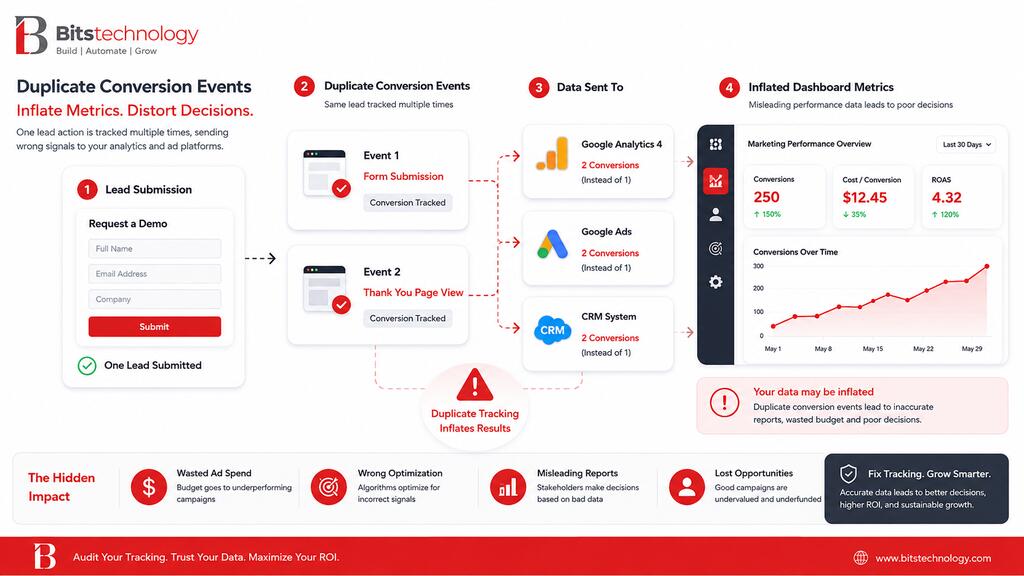
Pitfall #5 – Duplicate Conversion Events
One of the most common tracking mistakes businesses make is allowing the same conversion to be recorded multiple times. This often happens when both a form submission event and a thank-you page view are configured as conversions, causing a single lead to be counted twice.
Duplicate Conversion events create the illusion of better campaign performance. Marketing dashboards may show higher conversion rates, lower cost-per-acquisition, and stronger return on ad spend than what is actually happening in the business.
When conversion data is inflated, marketing teams often allocate more budget to campaigns that appear successful. Unfortunately, these decisions are based on inaccurate reporting rather than genuine business outcomes, resulting in wasted advertising spend.
Duplicate tracking can also affect optimization algorithms used by platforms such as Google Ads and Meta Ads. These systems rely on conversion signals to identify high-performing audiences, and inaccurate data can lead them to optimize toward the wrong users.
Regular tracking audits, proper Google Tag Manager implementation, and thorough testing are essential to prevent duplicate conversions. Accurate measurement ensures businesses can trust their analytics, make informed decisions, and maximize marketing ROI with confidence.
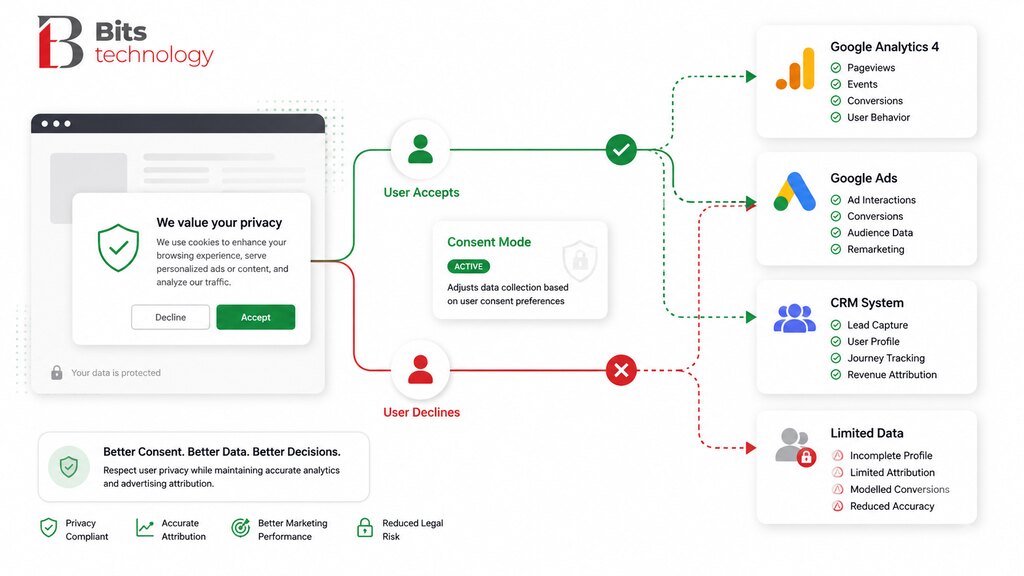
Pitfall #6 – Ignoring Consent Mode
One of the most overlooked tracking mistakes businesses make is ignoring consent management. Modern privacy regulations require websites to obtain user permission before collecting certain analytics and advertising data. Without a properly configured consent solution, tracking platforms may collect incomplete data, creating gaps in reporting and reducing confidence in marketing decisions.
Consent Mode helps businesses balance privacy compliance with measurement accuracy. When users decline tracking cookies, Consent Mode allows platforms such as Google Analytics and Google Ads to use privacy-safe signals and modeling techniques to estimate conversions and user behavior while respecting user preferences.
Without Consent Mode, businesses often experience significant drops in reported conversions, making campaigns appear less effective than they actually are. Marketing teams may mistakenly reduce budgets or pause high-performing campaigns based on incomplete attribution data.
Improper consent configuration can also create inconsistencies between analytics platforms, advertising dashboards, and CRM systems. This makes it difficult to identify which channels, campaigns, and keywords are truly generating qualified leads and revenue.
Implementing a compliant consent management platform alongside properly configured Consent Mode improves data quality, strengthens advertising attribution, and helps organizations make more informed decisions while reducing privacy-related risks. Accurate measurement starts with respecting user consent and ensuring tracking systems are configured correctly.
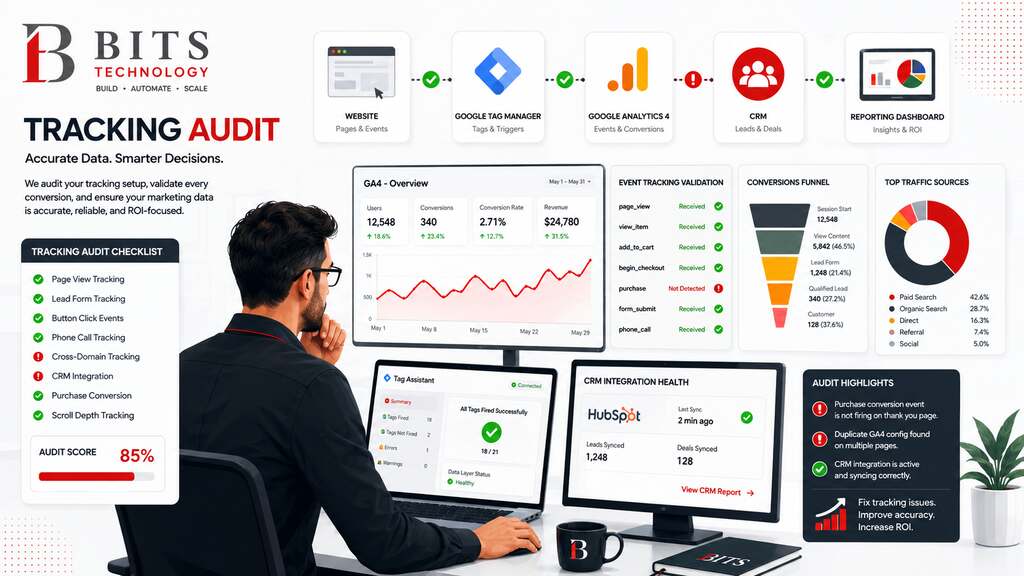
Pitfall #7 – No Tracking Audits
Many businesses assume their analytics setup will continue working indefinitely after installation. In reality, websites, forms, landing pages, plugins, and third-party tools change frequently. Even small updates can break conversion tracking, remove tracking parameters, or cause important events to stop firing. This is one of the most common tracking mistakes that leads to inaccurate reporting and poor marketing decisions.
Without regular tracking audits, marketing teams may unknowingly optimize campaigns using incomplete or incorrect data. A missing form submission event, duplicated conversion tag, or broken attribution path can significantly distort performance metrics and make successful campaigns appear ineffective.
Businesses should establish a routine process to validate critical tracking points, including lead forms, phone call tracking, appointment bookings, purchases, and CRM integrations. Testing these customer journeys regularly helps ensure that every conversion is recorded accurately from the first click to the final sale.
Tools such as Google Tag Manager Preview Mode, Google Tag Assistant, Google Analytics 4 DebugView, and CRM reporting dashboards should be used to verify that events are firing correctly and data is flowing consistently between platforms. This proactive approach helps identify issues before they impact revenue reporting.
Organizations that perform monthly or quarterly tracking audits gain greater confidence in their marketing data and decision-making process. Reliable analytics create a stronger foundation for optimization, automation, and growth, while reducing costly tracking mistakes that can quietly undermine marketing ROI.
The Cost of Bad Tracking
A home services company was spending $8,000 per month on Google Ads and believed its campaigns were performing exceptionally well. Google Analytics reported more than 120 monthly conversions, leading management to increase advertising budgets and expand into additional service areas.
After a detailed audit, several tracking mistakes were discovered. Form submissions were firing conversion events multiple times, phone call tracking was incomplete, and some leads were being counted even when forms failed to submit successfully. The reported conversion numbers were significantly inflated.
Because of this bad tracking, the marketing team shifted budget toward campaigns that appeared profitable but were actually generating low-quality leads. Meanwhile, high-performing campaigns received less investment because their true contribution was hidden by inaccurate data.
When CRM records were compared against analytics reports, the business found that actual qualified leads were nearly 35% lower than reported conversions. This revealed that several months of optimization decisions had been based on unreliable information.
Once the tracking issues were corrected, the company reallocated its advertising budget based on verified lead and revenue data. Within three months, marketing efficiency improved, customer acquisition costs decreased, and leadership gained confidence in the numbers used to guide business decisions.
Conclusion
Many businesses assume poor results mean they need a larger advertising budget. In reality, the problem is often inaccurate data. When critical conversion events, lead sources, or customer journeys are tracked incorrectly, marketing decisions become based on assumptions rather than facts. These tracking mistakes can quietly drain budgets while making campaigns appear more or less successful than they truly are.
Accurate tracking creates visibility into what is actually driving leads, sales, and revenue. It helps businesses identify high-performing channels, eliminate wasted spend, and make confident optimization decisions. Without reliable measurement, even the best marketing strategy becomes difficult to scale.
Investing in better tracking provides long-term value because every future marketing decision benefits from trustworthy data. From Google Tag Manager and GA4 to CRM attribution and dashboard reporting, a strong tracking foundation improves the effectiveness of every campaign.
The most successful organizations understand that data quality is not a technical task—it is a business advantage. Reliable analytics help teams align around facts, not opinions, and focus resources where they deliver the greatest return.
Better tracking beats bigger budgets. Before increasing ad spend, fix tracking mistakes, validate your data, and ensure every marketing decision is backed by accurate insights. The fastest way to improve marketing ROI is often improving measurement first.
Stop Making Marketing Decisions With Broken Data
Before increasing your ad budget, make sure your tracking foundation is accurate.
Bits Technology provides:
- Google Tag Manager Services
- GA4 Setup & Audits
- CRM Attribution Systems
- Marketing Dashboard Development
- Conversion Tracking Implementation