


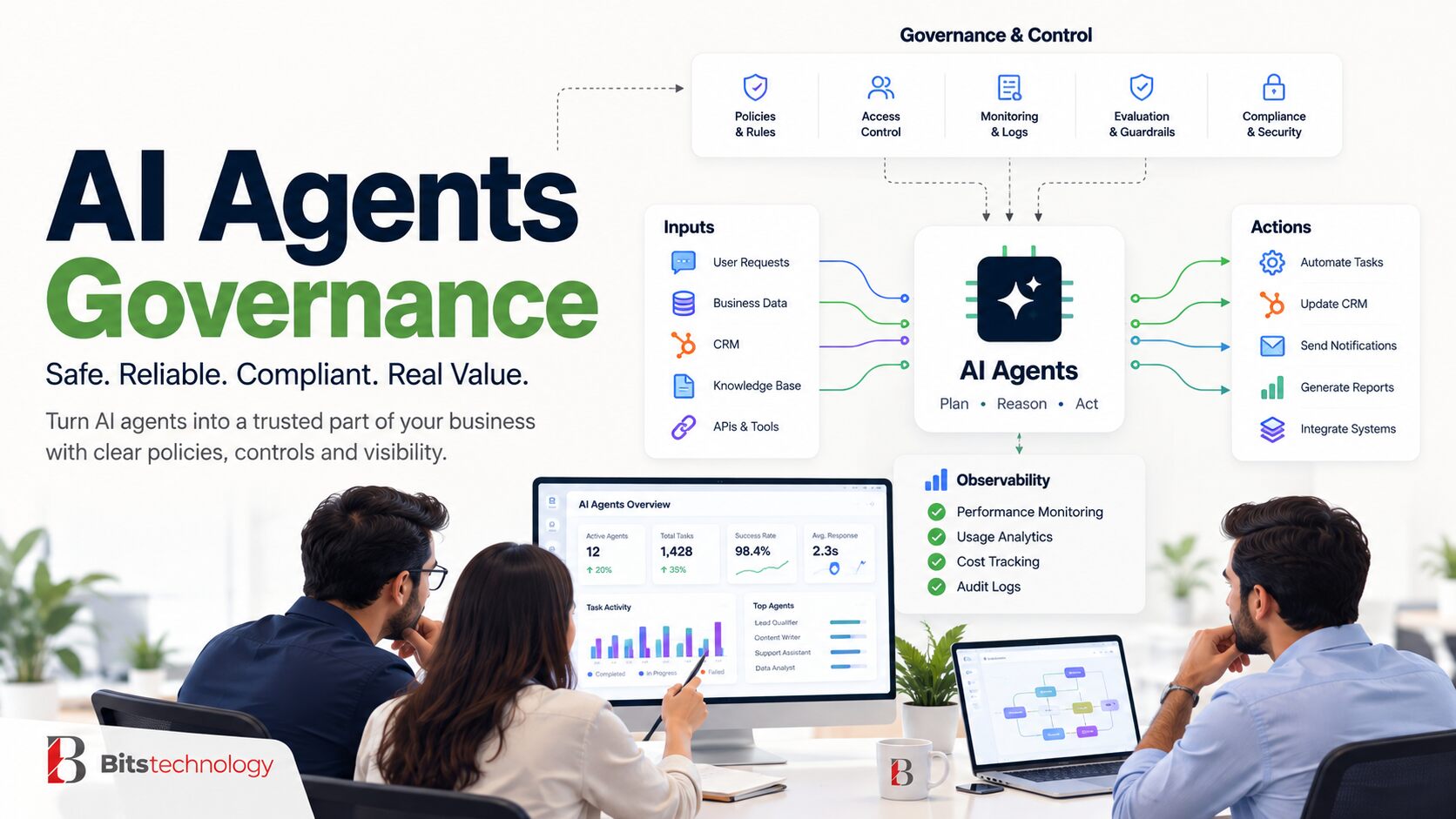
Agent governance is the set of rules, permissions, approval steps, and monitoring that controls what an AI agent is allowed to do and proves what it actually did. AI agents can take real actions: send emails, update your CRM, issue refunds, change records. Governance is the layer that keeps those actions safe, accountable, and aligned with your business. Without it, an agent is an unsupervised employee with system access. With it, an agent is a controlled, auditable part of your operations.
What is agent governance?
Agent governance is the framework of permissions, policies, human approvals, monitoring, and audit trails that determines what an AI agent can do, when it can do it, and who is accountable for the result.
A chatbot answers questions. An AI agent acts. It can read data, make decisions, call tools and APIs, and change things in your systems, often without a person watching each step. That shift from answering to acting is exactly why governance matters.
Think of it the way you would think about onboarding a new hire. You would not give someone day-one access to your bank account, customer database, and email system with no oversight. You would define their role, limit their access, review their early work and keep records. Agent governance applies the same discipline to software that can act on its own.
It is not a single product or a compliance checkbox. It is a design layer that sits between the agent’s intelligence and your business systems.
Why businesses need agent governance
Most businesses start AI agent governance too late. They start with a simple automation, and it works. Then the agent gets more tools, more access, and more autonomy. The risk grows quietly, without anyone deciding it should.
Here is what goes wrong without governance:
- Wrong actions at scale. A human makes one mistake at a time. An agent can repeat the same mistake hundreds of times before anyone notices.
- Data exposure. An agent with broad access can surface or send information to the wrong person.
- Unclear accountability. When something goes wrong, nobody can say what the agent did, why, or who approved it.
- Brand and customer damage. An agent that writes to customers in your name represents your business, including its errors.
- Cost overruns. Agents that loop, retry, or call paid tools without limits can burn through budget.
- Compliance exposure. Regulated data, contracts, and financial actions need records and controls.
Governance doesn’t slow AI adoption down. It is what lets a business give agents more responsibility with confidence, because the boundaries are clear.
AI agents vs. chatbots: why the difference matters
| Chatbot | AI agent | |
|---|---|---|
| Main function | Responds to questions | Takes actions toward a goal |
| System access | Usually none or read-only | Often read and write |
| Risk if wrong | A bad answer | A bad action with real consequences |
| Oversight needed | Light | Structured governance |
If your AI can only talk, you mostly need quality control. If it can do, you need governance.
The core components of agent governance
A practical governance framework has six parts. You don’t need all of them on day one, but you should know where each one sits.
1. Identity and permissions
Every agent should have its own identity and the minimum access it needs, no more. This is the principle of least privilege.
- Give each agent its own credentials, never a shared admin login.
- Separate read access from write access.
- Scope access by system, record type, and action (for example: “can draft invoices, cannot send them”).
2. Risk levels
Not every action deserves the same scrutiny. Classify what an agent can do into tiers:
- Low risk: reading data, drafting content, internal summaries. The agent can act freely.
- Medium risk: updating records, sending routine messages. The agent acts, but actions are logged and sampled for review.
- High risk: payments, deletions, contract changes, messages to key customers. These require approval.
Defining tiers up front means you make the risk decisions once, deliberately, instead of case by case under pressure.
3. Human approval (human-in-the-loop)
For high-risk actions, the agent prepares the work and a person approves it. Good human-in-the-loop design makes approval fast: the agent shows what it intends to do, why, and what the evidence is, so the reviewer can say yes or no in seconds.
Over time, as an agent proves reliable on a task, you can move that task down a risk tier. Trust is earned and recorded, not assumed.
4. Guardrails and limits
Guardrails are hard boundaries the agent cannot cross, regardless of what it “decides.”
- Spending caps and rate limits
- Allowed and blocked actions
- Approved data sources and recipients
- Maximum retries and loop limits
- Required formats and validation checks
Guardrails should be enforced in your systems, not just requested in a prompt. A prompt is a suggestion. A permission is a rule. To see how this works in practice, explore more AI and automation resources at wdnd.org.
5. Monitoring and observability
You should be able to see what your agents are doing in near real time:
- What actions did the agent take?
- What data did it use?
- What did it cost?
- Where did it fail, hesitate, or escalate?
- Are results drifting from what you expect?
Alerts for unusual behavior (a spike in actions, a new type of request, repeated failures) let you catch problems early.
6. Audit trails and accountability
Every meaningful action should leave a record: what happened, when, which agent, what inputs, what output, and who approved it. Audit trails support troubleshooting, customer disputes, internal review, and compliance. They also assign clear ownership: every agent should have a named human owner.
A simple agent governance framework you can start with
If you are early in your AI adoption, start small:
- Inventory your agents. List every AI agent or automation that can take action, and what systems it touches.
- Assign an owner. One accountable person per agent.
- Map the actions. List what each agent can do and classify each action as low, medium, or high risk.
- Restrict access. Cut permissions down to what the agent actually needs.
- Add approval gates. Require human sign-off for high-risk actions.
- Turn on logging. Record every action in a reviewable form.
- Review regularly. Check logs, errors, and edge cases on a schedule, and adjust the rules.
This takes days, not months, and it covers most of the real-world risk.
Agent governance in practice: a lead-handling example
Imagine an AI agent that qualifies inbound leads, updates your CRM, and replies to prospects.
- Permissions: it can read lead data and write to specific CRM fields. It cannot delete records or export contacts.
- Risk levels: scoring a lead is low risk. Sending a standard follow-up is medium. Sending a custom quote or discount is high.
- Approval: quotes and discounts go to a salesperson to approve with one click.
- Guardrails: it can send a limited number of messages per lead and only from approved templates.
- Monitoring: a dashboard shows leads handled, messages sent, and escalations.
- Audit: every score, message, and CRM change is logged with the reasoning.
The agent still saves hours of work, but it now operates inside clear boundaries.
Common agent governance mistakes
- Relying on prompts for safety. Instructions to the model are not enforcement. Use real permissions.
- Giving agents admin access “to make it work.” This is the most common and most avoidable risk.
- No owner. Agents nobody owns are agents nobody monitors.
- Over-governing everything. Requiring approval for every action destroys the value of automation. Match controls to risk.
- Governing once and forgetting. Agents change as tools, prompts, and models change. Review regularly.
- No audit trail. If you can’t reconstruct what happened, you can’t fix it or defend it.
Key takeaways
- Agent governance controls what AI agents can do, with permissions, risk levels, approvals, guardrails, monitoring, and audit trails.
- It matters because agents act, and actions have consequences that can scale quickly.
- Start with least-privilege access, a simple risk classification, and human approval for high-risk actions.
- Enforce rules in your systems, not only in prompts.
- Good governance is what allows you to safely give agents more responsibility over time.
Frequently asked questions
What is agent governance in simple terms?
Agent governance is a set of rules and controls that decide what an AI agent is allowed to do, require human approval for risky actions, and keep a record of everything the agent does.
Why is agent governance important?
AI agents can take real actions in your business systems. Governance prevents costly mistakes, protects data, keeps actions accountable, and makes it safe to expand AI use.
What’s the difference between AI governance and agent governance?
AI governance is broader and covers ethics, policy, data use, and compliance for AI in general. Agent governance is the operational part focused on autonomous agents: their permissions, actions, approvals, and monitoring.
Do small businesses need agent governance?
Yes, in a lightweight form. Even a small business should limit agent access, require approval for high-risk actions, and keep logs. The framework can be simple and still effective.
What is human-in-the-loop?
Human-in-the-loop means a person reviews or approves an AI agent’s action before it takes effect, typically for high-risk or irreversible decisions.
How do I start governing my AI agents?
List your agents, assign an owner to each, classify their actions by risk, cut access to the minimum, add approval for high-risk actions, and turn on logging.
Next step
Building AI agents or automation into your business, or already running them and unsure how much control you have? Bits Technology helps businesses design AI and automation systems with the right guardrails from day one.
About the author
Arfan Mahmood is a Fractional CTO and Software Architect who helps founders and business owners turn technology into a growth advantage, from AI and automation to infrastructure and lead systems.